What is ISO 27001 & who is it for?
ISO 27001 is the global standard for information security management. It applies to any business or organisation that handles sensitive data. Its reach is broad, spanning multiple sectors, not just tech companies.
- B2B Tech & SaaS Companies: Enterprise clients may refuse to buy software from these companies unless they hold ISO 27001 certification to demonstrate that user data is secure.
- Healthcare & Financial Services: Organisations managing medical records or financial data use it to meet strict compliance requirements such as DTAC and DORA.
- Government Contractors & Professional Services: Law firms, accountants, and managed service providers use it to build client trust.
- Growing Startups: Fast-growing businesses adopt it early to build structure before scaling.

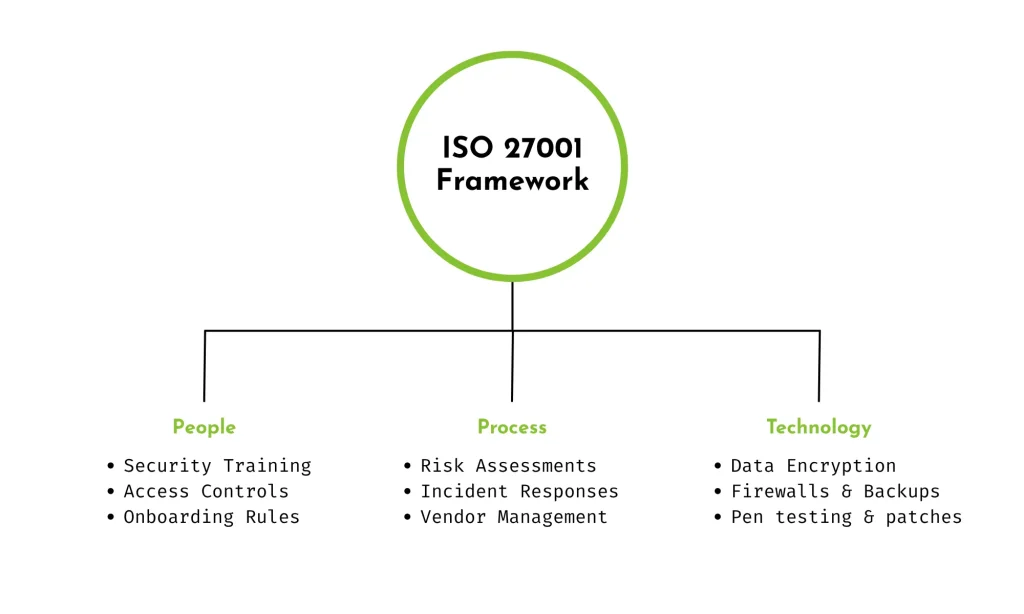
In a nutshell, ISO 27001 is a framework that guides businesses in protecting their data through a structured Information Security Management System (ISMS). The framework acts as an operational manual that addresses risks across people, processes and technology. It combines aspects such as training, operational policies, and technical safeguards, including encryption and penetration testing. By establishing a continuous cycle of risk assessment, companies demonstrate their treatment of data and cyber security with integrity and transparency.
Is Penetration Testing Required For ISO 27001?
While ISO 27001 doesn’t mandate penetration testing as a legal requirement, it does state in Annex A.8.8 (Management of Technical Vulnerabilities) and Annex A.8.29 (Security Testing in Development) that organisations must identify flaws in their systems and assess their exposure to technical risks. This makes a pen test a standard way to pass an audit.
So, while the framework doesn’t explicitly mention ‘penetration testing’, auditors treat it as essential proof to satisfy the above controls.
How Often Do You Need to Pen Test for ISO 27001?
ISO 27001 doesn’t specify a fixed frequency. However, most organisations will test:
- Annually to satisfy ongoing surveillance audits.
- After any significant change, such as a new product launch or major code release.
- Following a security incident, to confirm if the remediation actually closed the gap.
Auditors care less about the exact frequency of your testing and more about whether your testing schedule is documented and consistently followed. A single test from three years ago isn’t sufficient to satisfy an auditor, but a repeatable, up-to-date schedule is.
The ISO 27001 Certification Journey at a Glance
For businesses new to the process, certification typically follows a similar path:
- Gap Analysis: Compare current security practices against ISO 27001 requirements to identify what’s missing.
- Risk Assessment: Formally identify and score risks to information assets. This underpins the ISMS.
- ISMS Implementation: Roll out the policies, controls, and technical safeguards needed to address those risks.
- Internal Audit: Test the ISMS internally before inviting an external auditor in.
- Stage 1 & Stage 2 Certification Audits: The external auditor first reviews documentation, then assesses whether controls are genuinely operating as described.
- Surveillance Audits: Conducted annually (with recertification every three years) to confirm the ISMS remains effective. This is where up-to-date pen test evidence matters most.
Sencode provides CREST-accredited penetration tests for organisations that need to pass ISO 27001 audits. Our expert pen testers combine manual testing and automated scanning to produce comprehensive, actionable reports, along with complementary retests. Book a call with one of our testers or use our scoping tool to get your pen test quote today.