















What is Physical Penetration Testing?
Physical penetration testing, sometimes known as physical pentesting, is a strategic assessment designed to identify gaps in an organisation’s physical security controls. But what is physical penetration testing in practical terms? Generally speaking, physical penetration testing involves authorised professionals attempting to break into an organisation’s premises. Locks, doors, gates, access controls and elevators are common entry methods attackers use and typically come within the scope of an assessment. The aim is to reveal vulnerabilities before attackers can exploit them.
Common Physical Security Vulnerabilities
Find out if your organisation is vulnerable to these common physical security vulnerabilities.
What does choosing a CREST provider mean?
CREST accreditation is an independent, rigorous assessment of technical competence, process and data security. Choosing a CREST-accredited provider means your testing is delivered to a standard you can trust – and evidence you can stand behind.

Certified Penetration Testing Consultants
Our consultants are highly trained and individually certified.
Proven Pen Test Methodologies
Our pen testing follows recognised best practices: PTES, OWASP, and NIST.
Compliant reporting
Our reports provide executive context, technical evidence, risk-rated findings and practical remediation guidance.
ISO aligned
Our information security and quality policies align with ISO 27001 and ISO 9001.
Grey, Black and White Box Penetration Testing
At Sencode, we test from every perspective. Not sure which fits your needs? Speak to a member of our team; our experts are on hand to advise.
What does our Physical Penetration Testing Service include?
What are the benefits of a Physical Penetration Test?
Every Physical Pentest we conduct brings different benefits; no two organisations have the same outcome. Each test is designed to mimic a genuine threat, providing an accurate picture of how your site would fare against a determined intruder. Typical benefits often include:
Physical Penetration Testing Methodology
We discuss your objectives, define rules of engagement, and obtain the necessary permissions, ensuring our activities align with your organisation’s policies and compliance requirements.
Our team gathers information about your site layout, existing security controls, and typical employee routines. We use open-source intelligence (OSINT) and discreet on-site surveillance to identify likely entry points. Our team will conduct comprehensive corporate OSINT prior to attending the site to ensure a wide range of information has been collected, which closely mimics the actions of a real-world attacker.
With reconnaissance data in hand, we analyse potential vulnerabilities—weak locks, understaffed entrances, or flawed visitor protocols—and develop a plan of attack. This phase involves creating fake personas, pre-made copies of the organisation’s card access cards, and analysing floor plans and any other intelligence artefacts discovered during recon.
Our authorised testers attempt to bypass locks, barriers, and other defences. We also test employee awareness through social engineering methods tailored to the organisation under review, ensuring all activities conform to agreed rules.
Throughout the process, we meticulously log each successful or attempted breach, noting how quickly staff respond and which security measures are effective. This phase involves taking detailed photographs and covert video recordings to thoroughly document attack chains so senior management can assess successful exploits.
We compile a detailed report that outlines each identified weakness, the associated risk, and specific actions you can take to strengthen security. Our comprehensive reports will typically span dozens of pages, painting a complete picture of each assessment phase. This detailed approach to reporting allows senior management to properly mitigate the risks and fully understand the exposure and weaknesses which led to the exploitation.
We conduct a thorough debrief with your security team, discussing our findings, answering questions, and advising on remediation strategies for sustained improvement.
Contact a consulting team member by phone, email, or pigeon post. We will then discuss whether we can help you and arrange a scoping meeting to discuss your requirements.
In the scoping meeting, our team will discuss your requirements in further detail. Our team will ask questions in regards to the following:
Our expert consultants will discuss and finalise which digital assets you need testing in the scoping meeting. Based on the requirements, we will then assemble a project proposal and quote and agree on a schedule for conducting the security assessment. Our proposal document will include the following information:

The Penetration Testing starts. A member of our Penetration Testing team will liaise with a member of your company throughout the entire testing process. You will be the first to know if we have any questions or concerns. Our testing team will be on hand throughout the penetration test lifecycle to answer any questions or concerns. Our tester will:
A Penetration Test is useless without a well-written report. Our reports are written in plain English, concise, and thoroughly documented. The Penetration Test Report is typically furnished within 5 days after the testing phase is complete. If you are interested in seeing an example report, please contact our team.
Each report details the following:
At Sencode, we offer free retesting for every Penetration Test we conduct. You fix the issues; then we will verify they can no longer be exploited by an attacker. Our team will arrange a mutually suitable time to conduct the retest, after the remediation efforts have taken place. Our tester will follow these steps:
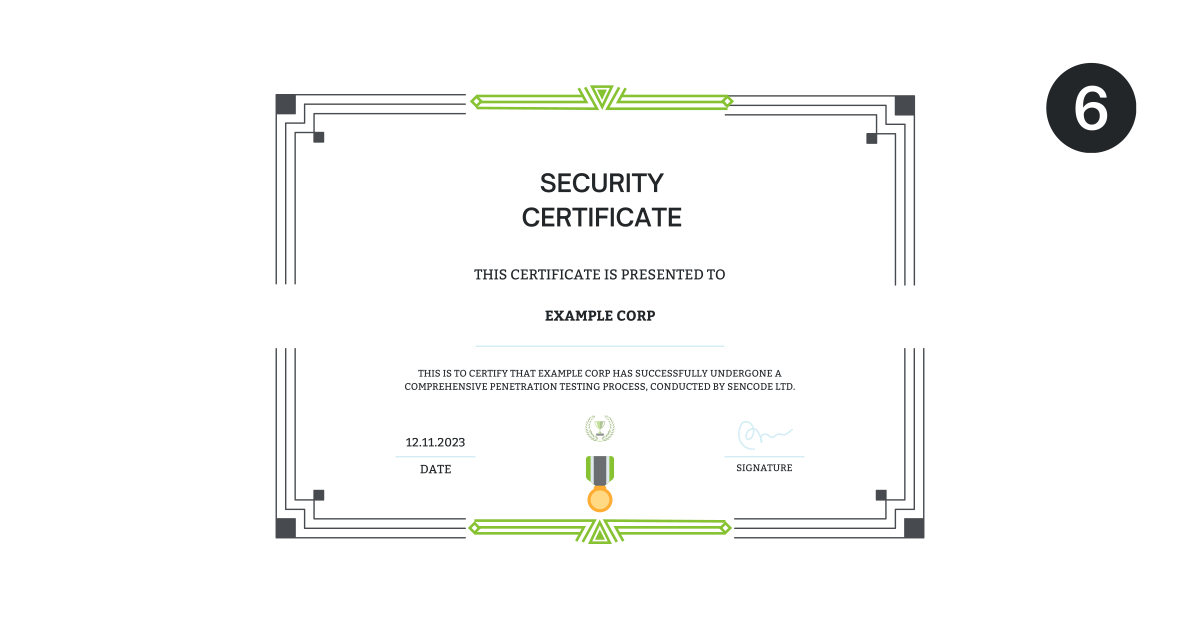
Our clients receive a testing certificate that can be shared with partners and customers, showing that their company takes security seriously. The certificate and document are designed to be easily digested by third-party suppliers, the document removes the technical details and can be safely distributed.
The Security Testing Certificate is available on request, after the retest has been complete. The security certificate shows:
Get in touch for a consultation.
Contact a consulting team member by phone, email, or pigeon post. We will then discuss whether we can help you and arrange a scoping meeting to discuss your requirements.
In the scoping meeting, our team will discuss your requirements in further detail. Our team will ask questions in regards to the following:
Client Testimonials
Don’t just trust our word for it; hear what our clients have to say about working with our team.
“The team at Sencode are flexible and easy to work with while also being extremely diligent and professional in what they do. As a result, we regard Sencode as a critical partner in ensuring our software is properly tested.”
Chief Technical Officer
Huler
“We held a briefing meeting with Callum to demo the system, answer relevant questions, and provide access for testing. Once the testing was completed, the report was efficient and comprehensive.”
Project Manager
Trinity College Dublin
“The team was super friendly, knowledgeable, and happy to chat with us. They did really great work, and I’m very happy that we got to work with them.”
IT Director
Diversity and Ability
“All conversations with Sencode have been very easy, and it’s clear that the team know their stuff. From the initial chat to the retesting process, we’ve been kept informed and supported throughout.”
Digital Lead
Verve Group
“Sencode have conducted our penetration testing for the last two years. Each time, they were professional, polite and kept us informed throughout the process. The reports were received in a timely manner and were concisely written. All this and at a competitive rate.”
Technical Engineer
Pip Studios
“Working with Sencode has been brilliant. You can tell they genuinely love what they do – it shows in how thoroughly they test everything and dig into the details. Even a non-tech person could understand what they found and what needed fixing.”
Cyber Security Specialist
Home Group
Frequently Asked Questions
Our physical penetration tests are designed to simulate real-world threats without causing unnecessary disruption. We work closely with your organisation beforehand to define a clear scope and rules of engagement while ensuring that our team’s abilities to perform a proper assessment are not limited. After all, simulating an actual intrusion involves attacking as though we are the intruder.
This ensures that while the test might involve attempting to bypass physical barriers or engage in social engineering, all activities remain controlled, authorised, and minimally intrusive to day-to-day operations.
Yes. We provide comprehensive post-assessment support, including customised employee training sessions, security awareness workshops, and detailed remediation guidance. We aim to help your team understand the identified weaknesses and reinforce best practices to maintain a robust security posture.
Typical tooling is dependent on the environment under review. However, you can expect the following items to be used, ranging from most common to least common:
RFID or access badge cloners (Most typical) – to assess vulnerabilities in electronic access systems.
Bypass devices – such as latch slips and under-the-door tools- defeat certain doors or locks.
Portable wireless scanners – to identify and evaluate network access points and signals near your premises. (Including rogue access points)
Camera or recording devices – for covert observation and documentation of weaknesses.
Binoculars – For covert, long-distance observation of premises.
Lock picking kits (Less common) – for testing the resilience of mechanical locks.
OSINT stands for Open-Source Intelligence. In the context of physical penetration testing, OSINT involves gathering publicly available information about your organisation, such as corporate building plans, employee routines, and security procedures found in social media posts, online forums, or official documents. This data helps penetration testers form an accurate picture of potential weaknesses before they step on-site. Typically, our team will conduct a thorough, multi-day assessment of the organisation under review, first digitally, then later physically on-site.
We strongly recommend a follow-up or retest once remediation measures have been implemented. This second evaluation verifies that the identified vulnerabilities have been effectively addressed and that no new gaps have emerged as a result of the changes.
To prepare for a physical pentest, you should first define the scope and objectives, ensuring it’s clear what you want to achieve and which areas or facilities are in scope; next, communicate appropriately with staff, staff member should be reminded of physical security protocols and company policies; confirm legal and regulatory requirements by obtaining necessary permissions and verifying compliance with local regulations and industry standards; and finally, plan logistics by coordinating schedules, authorisations, and any specific rules of engagement to minimise disruption.
Read the latest from our Cyber Security Blog



Explore Our Downloadable Resources
Penetration Testing Buyer’s Guide
Our Penetration Testing Buyer’s Guide 2025 outlines penetration testing fundamentals, service types, cost factors, testing approaches, and compliance considerations. Download a copy of our guide.

OWASP API Top 10 Flash Cards
The OWASP API Top 10 Flash Cards highlight critical security threats affecting modern APIs, including authorisation flaws, misconfigurations, and unsafe integrations and many more. Download a copy of the cards.