Penetration testing, commonly known as “pen testing,” is an authorised attack where trusted cyber security experts evaluate physical and digital systems, networks, or applications.
It is a form of ethical hacking, using the same tools as malicious cyber criminals but in an attempt to identify and safely exploit security weaknesses before a malicious attacker could use them to their advantage. It’s a defence mechanism used by organisations to create robust security infrastructures for their business.
Why is penetration testing important to business?
Pen testing is essential for cyber resilience. Many businesses rely on automated vulnerability scanning and assume they are protected. The main difference between the two is that automated scanning only detects weaknesses, whereas a pen test actively tries to exploit them. Penetration testers can chain a number of seemingly minor vulnerabilities together to exploit critical infrastructure, which could prove fatal in the wrong hands.
Without proactively testing your organisation’s defences, you could be leaving your business open to devastating financial loss due to data breaches, operational downtime or breakdown in consumer trust. Similarly, many industries require third-party security testing to meet regulatory standards such as the Digital Technology Assessment Criteria (DTAC), DORA and ISO 27001. While pen testing is not required by law for some industry criteria, it is recommended by many as a reputable and highly recognised form of cyber security testing.
Types of Penetration Testing Environments.
At Sencode, we offer an extensive range of services for a variety of sectors. Take a look at our services page for an exhaustive list of what we offer. Here are some of the most requested types of penetration testing services and their common vulnerabilities.
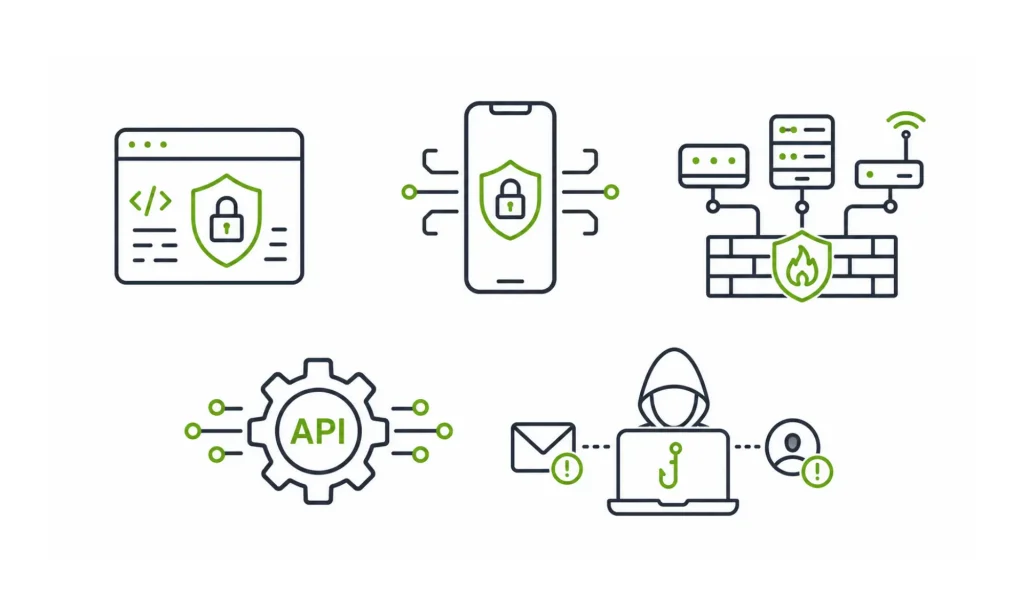
Web Application
Web app pen testing is a simulated attack that finds security flaws to protect data, meet compliance, and prevent costly breaches. Testers actively exploit critical vulnerabilities like broken access controls, outdated software, and injection attacks like SQLi and Cross-Site Scripting (XSS) before real hackers can hijack your systems.
Mobile Application
Mobile app pen testing simulates a cyberattack on iOS and Android applications to find security gaps before hackers can exploit them. Aligned with standards like OWASP MASVS, it prevents data leaks from lost devices and blocks breaches of connected APIs. Common flaws include insecure local data storage, weak encryption, broken authentication, and inadequate anti-tampering controls that let hackers reverse-engineer the app.
Network Infrastructure
Network penetration testing uncovers and exploits security gaps in your firewalls, routers, switches, and servers. It protects against data breaches and provides the compliance evidence needed for standards like GDPR and PCI-DSS. Common vulnerabilities include unpatched Windows machines, insecure firewalls, default credentials, unencrypted communications, weak network segregation, and outdated, legacy network protocols like NetBIOS and LLMNR.
API Testing
API pen testing simulates real-world attacks on the digital pipelines connecting your software to prevent data breaches and costly downtime. Testers actively probe for critical flaws like Broken Object Level Authorisation (BOLA), broken authentication, and Server-Side Request Forgery (SSRF), securing your backend before hackers can exploit them.
Phishing & Social Engineering
Rather than hunting software bugs, social engineering and phishing tests target human vulnerabilities to reveal how easily attackers can trick your staff into giving up data or access. By launching realistic, controlled attacks like spear-phishing, pretexting (impersonating a trusted authority), or physical tailgating, these tests identify critical gaps in your team’s security awareness before cybercriminals can exploit them.
How do penetration testers execute a pen test?
Sencode divides its penetration testing life cycle into five stages.
- Reconnaissance
- Scanning
- Gaining Access
- Maintaining Access
- Reporting
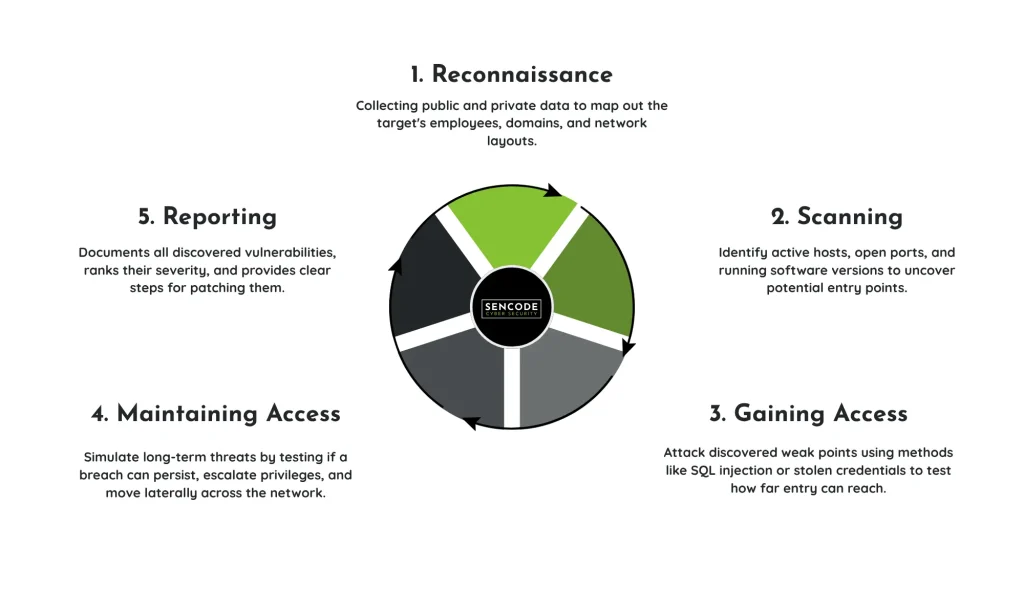
The test itself typically starts out with the tester gathering any data and information they might use to plan their attack through reconnaissance and scanning. Following this, the main focus is to gain and maintain access to the target and report on any successful exploitations.
Finding a reputable penetration testing company that won’t just use automated tools to test your security, leaving you with a long list of fixes, is half the battle. Sencode works directly with your technical teams to reduce alert fatigue and overwhelm by prioritising fixes based on business risk.
Whether this is your first pen test or looking to keep up with regular testing. At Sencode, we provide deep, objective clarity into your security posture, delivering actionable blueprints to lock down your network, applications, and cloud environments. Get in touch today for a free consultation and fixed-scope quote.
How to choose a trusted penetration testing company in the UK?
Sencode is a CREST-accredited pen testing company. CREST is the gold standard for penetration testing, threat intelligence, and cyber incident response. For ethical hackers, being CREST-approved means they have been thoroughly vetted by an unbiased certification body and genuinely know their stuff. View our comprehensive buyers’ guide for an in-depth look at penetration testing services, including typical costs and much more.
Many UK sectors strictly require a CREST-accredited provider like Sencode to conduct your penetration tests before doing business with you. For example, the Bank of England’s vulnerability testing framework (CBEST) strictly mandates CREST-qualified testers. Explore our penetration testing services today.
Our pen testers work under strict Rules of Engagement (RoE). They coordinate with your team to define boundaries, schedule tests during off-peak hours, and avoid disruptive exploits unless explicitly asked to test system resilience. It’s a controlled simulation, not malicious hacking.
The most valuable part of a pen test is the report. This document ranks the discovered vulnerabilities by severity and explains how they were exploited, helping you find ways to patch them. Another way we support you at Sencode is by offering free retesting. This ensures that the changes you have made are secure and effective.