














Manufacturing Cyber Security Challenges
Manufacturers depend on connected corporate networks, cloud platforms, remote access services, suppliers and production systems to keep operations moving.
This connectivity improves efficiency, but it can also create routes from ordinary business systems into sensitive engineering and operational environments. A compromised account, an exposed remote-access service, or a poorly segmented network may allow an attacker to steal intellectual property, disrupt production, or move closer to critical machinery.
Effective cyber security in manufacturing requires a clear understanding of how these systems are exposed and whether existing controls prevent realistic attacks.
Legacy and Difficult-to-Patch Systems
Manufacturing environments often rely on older software, operating systems, and equipment that cannot be easily updated.
Intellectual Property and Sensitive Data
Manufacturers hold valuable information, including engineering designs, CAD files, product specifications, formulas and commercial data.
Production Downtime
A security incident affecting production can cause missed orders, contractual penalties, supply chain disruption, and significant recovery costs.
Benefits of Penetration Testing for Manufacturing & Engineering
Manufacturing penetration testing provides evidence of how attackers could reach the systems, information and services your operations depend on.
Sencode provides practical cyber security testing and reporting that help manufacturers evidence their security posture and make informed remediation decisions.
Identify Real Attack Paths
Understand how an attacker could enter through exposed infrastructure, compromised accounts, insecure applications or remote-access services and move deeper into the environment.
Protect Production Uptime
Identify weaknesses that could contribute to ransomware, system outages or unauthorised access before they interrupt production.
Strengthen IT and OT Segmentation
Assess whether security controls prevent users or attackers on the corporate network from reaching sensitive engineering and operational systems.
Protect Intellectual Property
Determine whether engineering data, product designs and commercially sensitive information can be accessed or extracted without authorisation.
Cyber Security Services for Manufacturing & Engineering
Web Application Penetration Testing
Assess supplier portals, customer platforms, internal business applications and operational dashboards.
Network Penetration Testing
Assess internal or external networks for vulnerabilities, weak permissions, insecure configurations and opportunities for privilege escalation or lateral movement.
API Penetration Testing
Assess the APIs that connect your SaaS application, customer integrations, mobile products, and third-party services.
Mobile Application Penetration Testing
Assess iOS and Android applications connected to your SaaS platform.
Cloud Penetration Testing
Assess AWS, Microsoft Azure and Google Cloud environments supporting manufacturing operations, data platforms and remote-monitoring services.
Social Engineering Testing
Assess how employees respond to controlled phishing and other authorised social-engineering scenarios.
Supporting Manufacturing Security and Assurance
Manufacturers may need to demonstrate that appropriate security controls are in place to satisfy customers, auditors, insurers and supply-chain partners.
Sencode provides independent technical testing and reporting that can support these assurance activities. Penetration testing does not itself provide certification or compliance.
IEC 62443
The ISA/IEC 62443 series defines requirements and processes for securing industrial automation and control systems. Penetration testing can help assess technical controls, segmentation and exposure within environments using IEC 62443 as a security reference.
NIS and NIS2
Relevant manufacturers operating in the EU or supplying regulated organisations may be subject to NIS2 security and resilience requirements. In the UK, organisations should consider the existing NIS Regulations and, where applicable, the forthcoming reforms. Penetration testing can provide technical evidence to support broader risk management and resilience activities.
ISO 27001
Penetration testing can provide supporting evidence for vulnerability management, risk treatment and the assessment of technical controls within an ISO 27001-aligned information security management system.
Our Manufacturing Penetration Testing Process
Contact a consulting team member by phone, email, or post. We will then discuss whether we can help you and arrange a scoping meeting to discuss your requirements.
In the scoping meeting, our team will discuss your requirements in further detail. Our team will ask questions regarding the following:
- Assets
- Asset Locations
- Test Perspective
- Objectives
- Scoping
- Date & Time
- Technologies
- Frameworks
Our expert consultants will discuss and finalise which digital assets you need testing in the scoping meeting. Based on the requirements, we will then assemble a project proposal and quote and agree on a schedule for conducting the security assessment.
Our proposal document will include the following information:
- Client Information
- Test Perspective
- Test Constraints
- Test Framework
- Scope Information
- Determined Scope
- Deliverables
- Quote & Authorisation (Signature)

The Penetration Testing starts. A member of our Penetration Testing team will liaise with a member of your company throughout the entire testing process. You will be the first to know if we have any questions or concerns. Our testing team will be on hand throughout the penetration test lifecycle to answer any questions or concerns.
Our tester will:
- Keep you updated
- Provide end of day summaries
- Liaise with the point of contact
- Test using a strict methodology
- Document evidence
- Maintain confidentiality
- Provide real-time alerts
- Deliver detailed reports
A Penetration Test is useless without a well-written report. Our reports are written in plain English, concise, and thoroughly documented. The Penetration Test Report is typically furnished within 5 days after the testing phase is complete. If you are interested in seeing an example report, please contact our team.
Each report details the following:
- Context & Objectives
- Mailing List
- Period and Confidentiality
- Perimeter & Scope
- Environment Overview
- Executive Summary
- Findings Summary & Table
- Technical Details
At Sencode, we offer free retesting for every Penetration Test we conduct. You fix the issues; then we will verify they can no longer be exploited by an attacker. Our team will arrange a mutually suitable time to conduct the retest, after the remediation efforts have taken place.
Our tester will follow these steps:
- Arrange Access
- Ask what issues have been resolved
- Retest the issues in the report
- Provide end of day summaries
- Update the document
- Deliver the document
- Offer a retest debriefing
- Debrief with your team
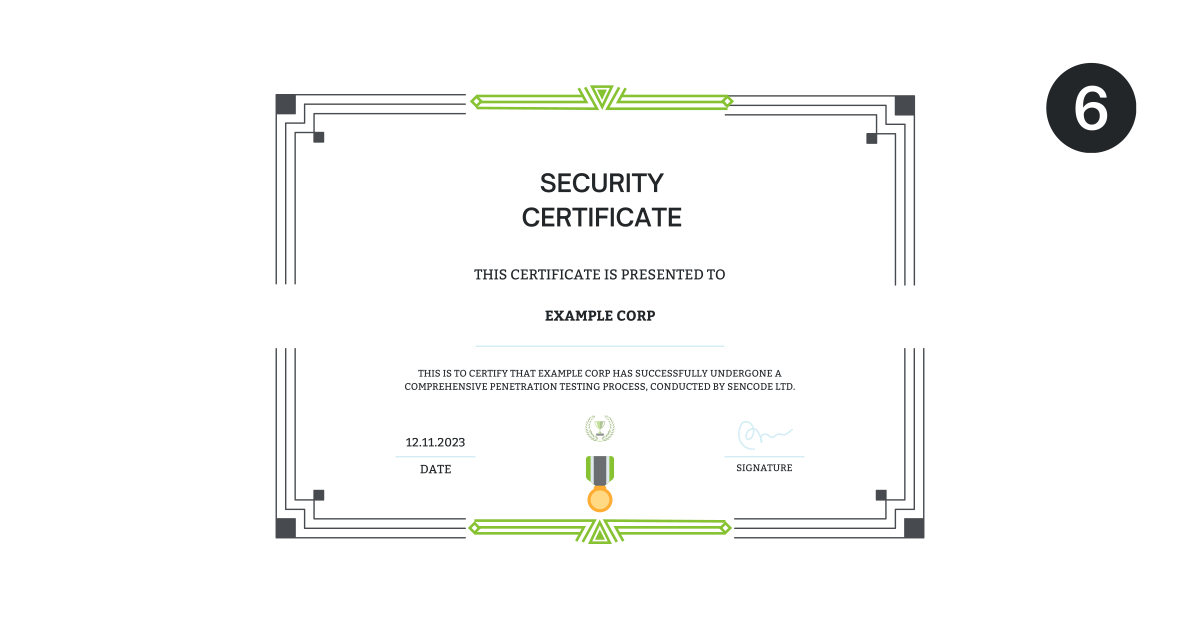
Our clients receive a testing certificate that can be shared with partners and customers, showing that their company takes security seriously. The certificate and document are designed to be easily digested by third-party suppliers; the document removes the technical details and can be safely distributed.
The Security Testing Certificate is available on request after the retest has been completed. The security certificate shows:
- Date of the assessment
- Company name
- Client name
- Outstanding issues
- Resolved Issues
- Updated risk profile
- Environment Overview
- Executive Summary
What does choosing a CREST provider mean?
CREST accreditation is an independent, rigorous assessment of technical competence, process and data security. Choosing a CREST-accredited provider means your testing is delivered to a standard you can trust – and evidence you can stand behind.

Certified Penetration Testing Consultants
Our consultants are highly trained and individually certified.
Proven Pen Test Methodologies
Our pen testing follows recognised best practices: PTES, OWASP, and NIST.
Compliant reporting
Our reports provide executive context, technical evidence, risk-rated findings and practical remediation guidance.
ISO aligned
Our information security and quality policies align with ISO 27001 and ISO 9001.
Grey, Black and White Box Penetration Testing
At Sencode, we test from every perspective. Not sure which fits your needs? Speak to a member of our team; our experts are on hand to advise.
Client Testimonials
Don’t just trust our word for it; hear what our clients have to say about working with our team.
“The team at Sencode are flexible and easy to work with while also being extremely diligent and professional in what they do. As a result, we regard Sencode as a critical partner in ensuring our software is properly tested.”
Chief Technical Officer
Huler
“We held a briefing meeting with Callum to demo the system, answer relevant questions, and provide access for testing. Once the testing was completed, the report was efficient and comprehensive.”
Project Manager
Trinity College Dublin
“The team was super friendly, knowledgeable, and happy to chat with us. They did really great work, and I’m very happy that we got to work with them.”
IT Director
Diversity and Ability
“All conversations with Sencode have been very easy, and it’s clear that the team know their stuff. From the initial chat to the retesting process, we’ve been kept informed and supported throughout.”
Digital Lead
Verve Group
“Sencode have conducted our penetration testing for the last two years. Each time, they were professional, polite and kept us informed throughout the process. The reports were received in a timely manner and were concisely written. All this and at a competitive rate.”
Technical Engineer
Pip Studios
“Working with Sencode has been brilliant. You can tell they genuinely love what they do – it shows in how thoroughly they test everything and dig into the details. Even a non-tech person could understand what they found and what needed fixing.”
Cyber Security Specialist
Home Group
Frequently Asked Questions: Manufacturing Cyber Security
Testing is planned around your operational and safety requirements. Before work begins, we agree on which systems may be tested, excluded or handled only during maintenance windows. Where live testing would pose an unacceptable risk, we can focus on supporting infrastructure, segmentation controls, replica environments, or other agreed-upon assets. We do not perform disruptive testing against production machinery without explicit agreement and appropriate safeguards.
We can assess the networks, remote-access services, supporting infrastructure and security boundaries surrounding operational technology. Direct testing of PLCs, control systems or sensitive production equipment requires careful planning and may be restricted to approved techniques or non-production environments.
Our reports can provide technical evidence to support broader IEC 62443 or ISO 27001 assurance activities. They document the agreed scope, testing methodology, findings, risk ratings and remediation recommendations. A penetration test does not, by itself, certify compliance with either standard.
Contact us
Get a free, no obligation quote from one of our expert staff.