












Types of Pen Testing Services we offer
Web Application
OWASP-aligned testing to identify security weaknesses in web applications, portals, and SaaS platforms. Covers authentication, session management, access controls, injection flaws, and business logic.
Network and Infrastructure
Internal and external assessments of network infrastructure, services, configurations, and patch levels. Delivered by CREST-registered consultants following PTES methodology.
Mobile Application
Static and dynamic analysis for iOS and Android applications. Aligned to OWASP MASVS with coverage of data storage, network communication, and platform interaction.
API
Security validation of REST, SOAP, and GraphQL endpoints. Identifies broken authentication, injection, excessive data exposure, and OWASP API Top 10 issues.
Benefits of Penetration Testing
Our Penetration Testing Services can help identify and patch security issues before malicious hackers exploit them. Early identification and remediation of security issues are critical to maintaining a secure posture. Understanding potential attack vectors in a networked environment can help an organisation develop effective incident response strategies.
From Scope to Report – Step by Step
Contact a consulting team member by phone, email, or pigeon post. We will then discuss whether we can help you and arrange a scoping meeting to discuss your requirements.
In the scoping meeting, our team will discuss your requirements in further detail. Our team will ask questions in regards to the following:
Our expert consultants will discuss and finalise which digital assets you need testing in the scoping meeting. Based on the requirements, we will then assemble a project proposal and quote and agree on a schedule for conducting the security assessment. Our proposal document will include the following information:

The Penetration Testing starts. A member of our Penetration Testing team will liaise with a member of your company throughout the entire testing process. You will be the first to know if we have any questions or concerns. Our testing team will be on hand throughout the penetration test lifecycle to answer any questions or concerns. Our tester will:
A Penetration Test is useless without a well-written report. Our reports are written in plain English, concise, and thoroughly documented. The Penetration Test Report is typically furnished within 5 days after the testing phase is complete. If you are interested in seeing an example report, please contact our team.
Each report details the following:
At Sencode, we offer free retesting for every Penetration Test we conduct. You fix the issues; then we will verify they can no longer be exploited by an attacker. Our team will arrange a mutually suitable time to conduct the retest, after the remediation efforts have taken place. Our tester will follow these steps:
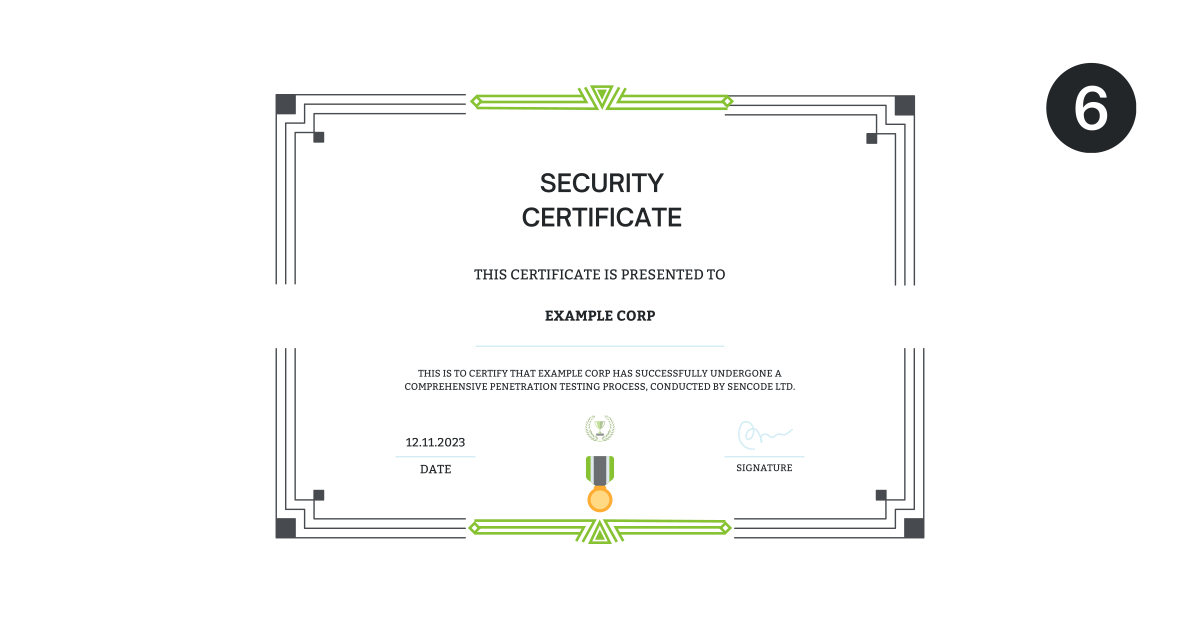
Our clients receive a testing certificate that can be shared with partners and customers, showing that their company takes security seriously. The certificate and document are designed to be easily digested by third-party suppliers, the document removes the technical details and can be safely distributed.
The Security Testing Certificate is available on request, after the retest has been complete. The security certificate shows:
Get in touch for a consultation.
Contact a consulting team member by phone, email, or pigeon post. We will then discuss whether we can help you and arrange a scoping meeting to discuss your requirements.
In the scoping meeting, our team will discuss your requirements in further detail. Our team will ask questions in regards to the following:
What does choosing a CREST provider mean?
What is included in our Pen Testing Services?
Get a rapid Quote
Talk to an expert today about our Pen Testing Services
Advanced scanning combined with expert manual exploitation
Granular breakdowns of every identified vulnerability
Clear, step-by-step remediation guidance for every threat
Easily track and manage your remediations through our secure portal
Gain a clear, executive-level view of your entire security posture
Grey, Black and White Box Penetration Testing Services


Common Penetration Testing Service Vulnerabilities
Cross-Site Scripting
Security Misconfigurations
Weak Password Policies
Outdated Software
Exports Ports and Services
Weak Encryption
Want to find out if your assets have these vulnerabilities?
Our Penetration Testing Methodology
Define the assessment’s scope and objectives and the rule of engagement and obtain the necessary authorisation to conduct the evaluation. It’s crucial to establish clear communication channels with the point of contact and agree on testing boundaries.
The relevant documentation and credentials will be given to the tester to conduct the assessment. Network security teams will be notified of the penetration testing activities. Dedicated contact points will be established to ensure consistent communication between both parties.
Collect information about the target systems, network and applications. The tester will perform passive and active enumeration of the target systems. This intelligence will help guide the planning and preparation for the vulnerability scanning of the targets.
The tester will identify known vulnerabilities in the target systems using manual and automated methods. The tester may utilise several vulnerability scanning tools, such as Nmap, Nessus, Burp Suite, or Nuclei, as well as many manual techniques. These techniques allow the tester to collate data about potential attack paths and vectors that may be accessible to them during the exploitation phase.
The tester will attempt to exploit any identified vulnerabilities and push them to their utmost limits, utilising known methods to exploit the identified vulnerabilities. Scripting and proxy tools are used to manually and automatically manipulate the systems.
The tester will assess the extent of access gained during the exploitation phase and determine its potential impact. The tester may pivot and explore the compromised environment to further collect evidence of potential privilege escalation vectors.
The report will be compiled, and the penetration test results will often be presented to the client during a debriefing, detailing the exploitation steps, impact, and remediation of the identified issues.
The client will aim to implement the remediation of the identified vulnerabilities shortly after. The tester will retest the target environment to verify that the issues have been resolved and are no longer exploitable.

Penetration Test Reports, Delivered.
Our comprehensive, professional reports clearly communicate risks, provide detailed remediation guidance, and demonstrate compliance with industry standards. Our deliverables are available through the Sencode Portal or accessible via a downloadable PDF.
Frequently Asked Questions: Penetration Testing Service
A penetration testing service uncovers critical vulnerabilities that are often missed when developing networked environments or digital applications. Despite developers’ best efforts, time, budget, and expertise constraints can leave gaps in IT security. Pen Testing identifies these hidden flaws, secures your digital environment against cyber threats and cyber-attacks, and ensures a more secure and resilient infrastructure as a whole.
The penetration testing cost can vary from £1000 to tens of thousands of pounds. It is determined during the project’s scoping and is influenced by factors such as the testing perspective, the volume of IP addresses, and the complexity of the assets. For information regarding penetration test costs, read our detailed blog.
Yes, Penetration Testing is a vital component of vulnerability management. Penetration testing helps to identify vulnerabilities in digital systems by simulating attacks against them. Vulnerability Scanners do not detect all vulnerabilities; some require a skilled professional’s keen eye to identify them. Regular penetration testing should be part of a continuous vulnerability management cycle.
Using the same supplier can have advantages and disadvantages that organisations should consider.
Some of the benefits include:
* Familiarity with the systems tested can increase efficiency and result in more focused testing.
* Long-term business relationships can result in favourable rates for the client.
* The Penetration Testing provider will often follow the same methodology on each assessment, allowing the client to track improvements more clearly over time.
Yes, Penetration Testers can complete many assessments remotely. Web Applications are nearly always accessible over the Internet, so they have few requirements for remote access. Internal Network Infrastructure can be conducted remotely, provided an adequate device has been sent to the location under review or a local device configured for the tester to connect remotely.
Assessments that Penetration Testers could do remotely include:
* Mobile Application Testing
* Web Application Testing
* Internal Network Testing
* External Network Testing
* API Testing
* Cloud Security Reviews
* Red Team Assessments
No, ISO 27001 does not explicitly mandate that a company undergo a Penetration Test. However, it emphasises the importance of information security risk management, often including penetration testing as a best practice for identifying and mitigating security risks.
Our Penetration Testing Service can help your company comply with ISO 27001.
In an ideal world, a company should conduct penetration testing annually to verify that the security controls in place are sufficient. To provide some basic guidance:
Annually: At a minimum, a company should budget to conduct a penetration test once a year.
After significant changes: Major updates or upgrades of a digital asset can often expose it to new vulnerabilities; examples of changes include primary code or infrastructure changes to an application, cloud migrations, or major software updates and system upgrades.
Compliance: In many industries, specific regulatory requirements dictate the frequency of penetration testing. To provide an example, PCI-DSS requires penetration testing at least annually and after any significant change.