











What is AI & LLM Penetration Testing?
AI and LLM penetration testing is the process of identifying and validating vulnerabilities in AI-driven systems before attackers can exploit them, then providing the evidence and guidance needed to remediate those weaknesses. This includes large language models such as Claude, GPT and Gemini, the applications built around them, and autonomous agents that use models to access data, tools and other systems.
A Sencode AI penetration test draws on frameworks such as the OWASP Top 10 for LLM Applications and MITRE ATLAS. Testing is delivered by experienced consultants within a CREST-accredited penetration testing provider, helping organisations strengthen the security of their AI systems and protect sensitive data in a rapidly evolving threat landscape.
Benefits of penetration testing for AI & LLMs
AI adoption is advancing rapidly and has become part of everyday life for workers and consumers. However, the speed of integration has outpaced security capacity in many organisations. AI and LLM penetration testing helps teams understand how their models, data and connected applications could be manipulated before those weaknesses are exploited.
Common AI & LLM vulnerabilities
Prompt injection
Improper output handling
Sensitive information and system prompt disclosure
Data, model and RAG poisoning
Excessive agency
Supply chain and plugin security
Want to find out if your assets have these vulnerabilities?
Client Testimonials
Don’t just trust our word for it; hear what our clients have to say about working with our team.
“The team at Sencode are flexible and easy to work with while also being extremely diligent and professional in what they do. As a result, we regard Sencode as a critical partner in ensuring our software is properly tested.”
Chief Technical Officer
Huler
“We held a briefing meeting with Callum to demo the system, answer relevant questions, and provide access for testing. Once the testing was completed, the report was efficient and comprehensive.”
Project Manager
Trinity College Dublin
“The team was super friendly, knowledgeable, and happy to chat with us. They did really great work, and I’m very happy that we got to work with them.”
IT Director
Diversity and Ability
“All conversations with Sencode have been very easy, and it’s clear that the team know their stuff. From the initial chat to the retesting process, we’ve been kept informed and supported throughout.”
Digital Lead
Verve Group
“Sencode have conducted our penetration testing for the last two years. Each time, they were professional, polite and kept us informed throughout the process. The reports were received in a timely manner and were concisely written. All this and at a competitive rate.”
Technical Engineer
Pip Studios
“Working with Sencode has been brilliant. You can tell they genuinely love what they do – it shows in how thoroughly they test everything and dig into the details. Even a non-tech person could understand what they found and what needed fixing.”
Cyber Security Specialist
Home Group
What is included in our AI & LLM penetration testing services?
What does choosing a CREST provider mean?
CREST accreditation is an independent, rigorous assessment of technical competence, process and data security. Choosing a CREST-accredited provider means your testing is delivered to a standard you can trust – and evidence you can stand behind.
Certified Penetration Testing Consultants
Our consultants are highly trained and individually certified.
Proven Pen Test Methodologies
Our pen testing follows recognised best practices: PTES, OWASP, and NIST.
Compliant reporting
Our reports provide executive context, technical evidence, risk-rated findings and practical remediation guidance.
ISO aligned
Our information security and quality policies align with ISO 27001 and ISO 9001.
Grey, Black and White Box Penetration Testing
At Sencode, we test from every perspective. Not sure which fits your needs? Speak to a member of our team; our experts are on hand to advise.
Methodology for penetration testing AI systems
We agree the systems, models, environments, user roles and objectives in scope, then document rules of engagement and provider restrictions. The architecture is threat-modelled to identify sensitive data, trust boundaries, agent capabilities and the attack paths that require the greatest testing depth.
Consultants map every route through which data or instructions can reach the model. This can include user prompts, file uploads, APIs, emails, web content, RAG sources, memory and messages from other agents. The resulting input map guides direct and indirect prompt injection testing.
We assess the infrastructure and services surrounding the AI model, including authentication, APIs, cloud configuration, third-party dependencies, plugins and access controls. This determines whether a weakness outside the model could expose data, bypass safeguards or expand the impact of a successful AI-layer attack.
The model is probed directly for prompt injection, jailbreaking, guardrail bypass and unsafe behaviour. Because LLM output is non-deterministic, consultants vary syntax, context and sequencing; where appropriate, a technique may be repeated across 8–12 attempts before a conclusion is reached.
We examine how system prompts, instruction hierarchies, content filters and other guardrails govern behaviour. Testing attempts to override, expose or create conflicts within those instructions, establishing whether protected prompts can be disclosed or intended restrictions can be bypassed.
Consultants test what data the system can retrieve, disclose or use to shape its answers. Training sources, vector stores, knowledge bases and RAG workflows are assessed for poisoning, access-control failures, cross-user leakage and malicious content that could influence future model behaviour.
The application layer, model output, connected tools and autonomous actions are tested as one system. We assess output handling, function calling, permission boundaries and multi-agent communication to determine whether manipulated responses can trigger unauthorised data access, commands or system changes.
Where an initial weakness is confirmed, consultants assess whether it can be chained with other controls to reach additional data or systems. Findings are reproduced, evidenced and risk-rated before we deliver a clear report, practical remediation guidance and a consultant-led debrief. Remediated findings can then be retested.

Penetration test reports, delivered securely.
Clear reporting turns technical findings into practical action. Every engagement includes evidence, prioritised remediation guidance and content that both technical teams and decision-makers can understand.
Contact a consulting team member by phone, email, or pigeon post. We will then discuss whether we can help you and arrange a scoping meeting to discuss your requirements.
In the scoping meeting, our team will discuss your requirements in further detail. Our team will ask questions in regards to the following:
Our expert consultants will discuss and finalise which digital assets you need testing in the scoping meeting. Based on the requirements, we will then assemble a project proposal and quote and agree on a schedule for conducting the security assessment. Our proposal document will include the following information:
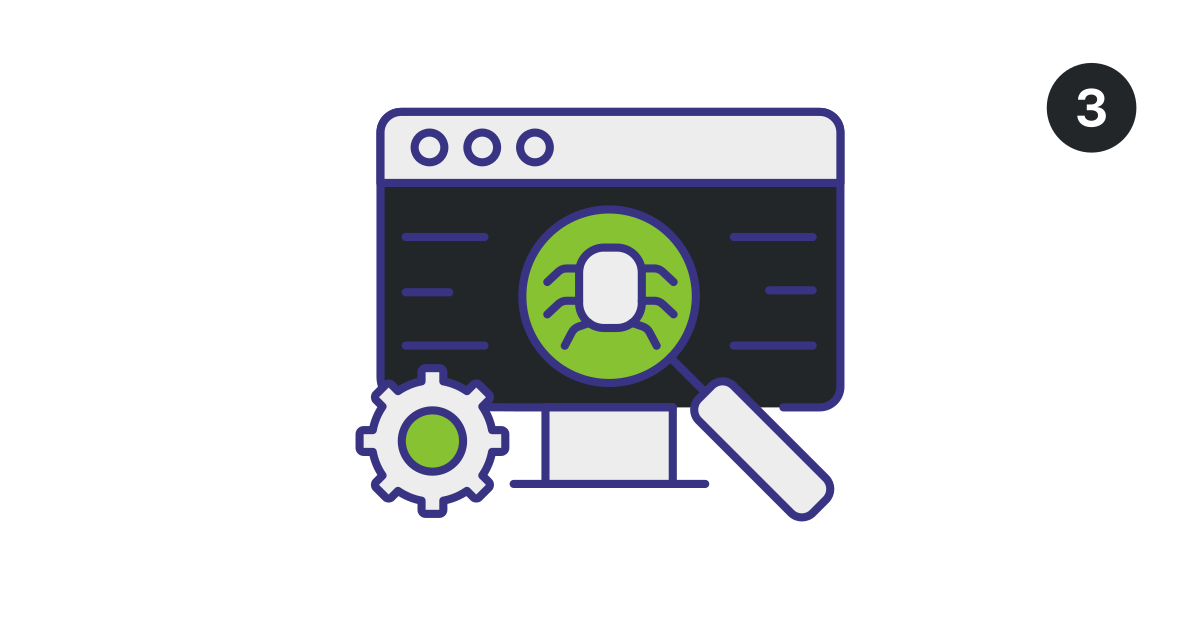
The Penetration Testing starts. A member of our Penetration Testing team will liaise with a member of your company throughout the entire testing process. You will be the first to know if we have any questions or concerns. Our testing team will be on hand throughout the penetration test lifecycle to answer any questions or concerns. Our tester will:
A Penetration Test is useless without a well-written report. Our reports are written in plain English, concise, and thoroughly documented. The Penetration Test Report is typically furnished within 5 days after the testing phase is complete. If you are interested in seeing an example report, please contact our team.
Each report details the following:
At Sencode, we offer free retesting for every Penetration Test we conduct. You fix the issues; then we will verify they can no longer be exploited by an attacker. Our team will arrange a mutually suitable time to conduct the retest, after the remediation efforts have taken place. Our tester will follow these steps:
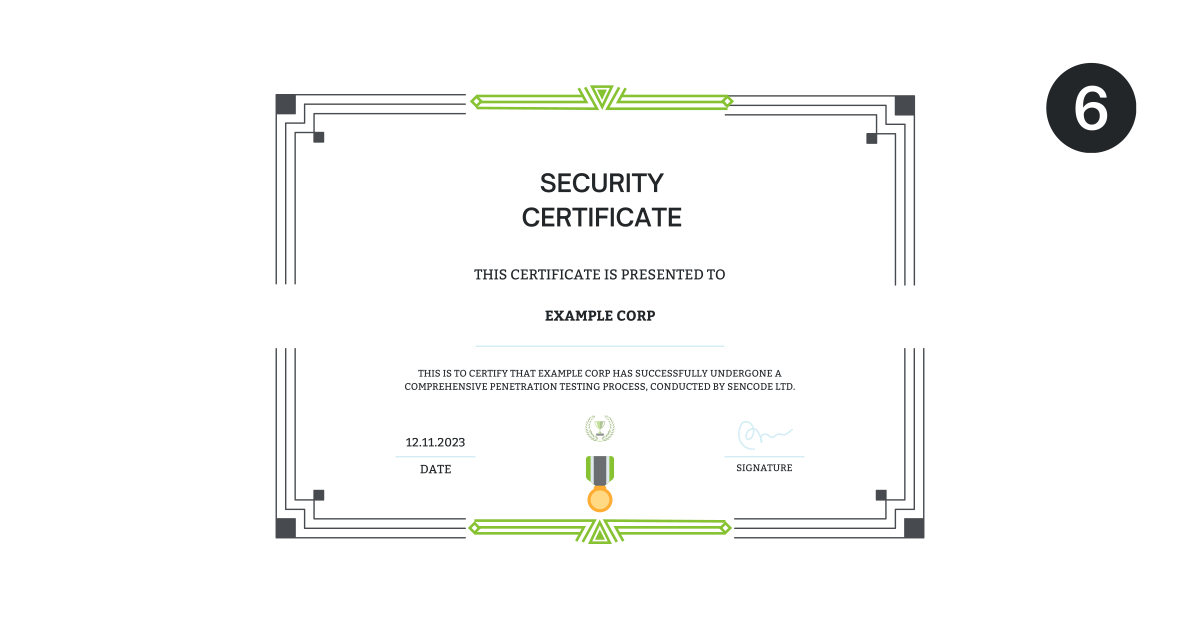
Our clients receive a testing certificate that can be shared with partners and customers, showing that their company takes security seriously. The certificate and document are designed to be easily digested by third-party suppliers, the document removes the technical details and can be safely distributed.
The Security Testing Certificate is available on request, after the retest has been complete. The security certificate shows:
Get in touch for a consultation.
Contact a consulting team member by phone, email, or pigeon post. We will then discuss whether we can help you and arrange a scoping meeting to discuss your requirements.
In the scoping meeting, our team will discuss your requirements in further detail. Our team will ask questions in regards to the following:
Frequently Asked Questions: AI & LLM Penetration Testing
ISO/IEC 42001 is an AI management system standard for organisations that develop, provide or use AI. AI and LLM penetration testing can support an organisation’s AIMS by providing evidence of technical risk assessments, control testing, and the treatment of vulnerabilities in deployed AI systems. It does not establish compliance on its own; testing should form part of wider governance, documentation, monitoring, and continual improvement processes.
We can assess applications built on model families such as Claude, Gemini, GPT, DeepSeek and Grok, as well as self-hosted and third-party open-source models. The exact approach depends on the deployment, the level of access available, the surrounding application and the provider’s testing terms. We confirm authorisation, scope and any platform restrictions before testing begins.
AI penetration testing is typically quoted on a fixed-scope basis, using the same commercial approach as our other penetration testing services. Price depends on the complexity of the application, the number of models and integrations, user roles, data sources, agent capabilities, and the required testing depth. Following a scoping discussion, we provide the assumptions, test effort, deliverables and fixed price before work begins. Read our penetration testing cost guide for further detail.
AI systems do not always fail in the same deterministic way as a web application or network service. A model may appear to operate as intended but still be manipulated into revealing information or taking unintended actions after repeated variations of an attack. Testing therefore combines conventional application and infrastructure techniques with specialist assessment of prompts, model behaviour, RAG data, guardrails, tools and agent permissions.
AI penetration testing assesses AI models, agents and the applications surrounding them through human-led manual and automated testing. AI-powered penetration testing instead uses AI tools to automate or assist stages of a penetration test against other types of systems. The terms are often used interchangeably, so organisations should confirm whether a supplier is testing an AI system or using AI to perform the testing before selecting a service. Specialist platforms such as XBOW are examples of tools designed to apply AI to parts of the penetration testing process.
Read the latest from our Cyber Security Blog

Explore Our Downloadable Resources
Penetration Testing Buyer’s Guide
Our Penetration Testing Buyer’s Guide 2025 outlines penetration testing fundamentals, service types, cost factors, testing approaches, and compliance considerations. Download a copy of our guide.
OWASP API Top 10 Flash Cards
The OWASP API Top 10 Flash Cards highlight critical security threats affecting modern APIs, including authorisation flaws, misconfigurations, and unsafe integrations and many more. Download a copy of the cards.